
Studio Vrij creative director & founder Mila Moleman and XR developer Sammy Speulman recently joined Saber and Kishen on CodeKlets, the Dutch podcast for developers. In a 65-minute deep dive, they discuss how we build location-based multiplayer VR installations for festivals and events, how we handle performance optimisation on standalone headsets, and when (and when not) to use AI in immersive experience design. Here are the key takeaways.
Location-based multiplayer VR: why shared experiences change everything
One of the central themes in the conversation is something we've mastered at Studio Vrij for years: VR is most powerful when you experience it together. Traditional VR is a solo affair; you put on the headset and disappear into your own world. Location-based multiplayer VR changes that entirely. Multiple people step into the same shared virtual space, at the same time, in the same physical space.
The impact is purely human - strangers walk in and leave with a shared story. A Place So Far at Festival of the Future, De Helling in Utrecht and Down The Rabbit Hole drew over 500 visitors a day.
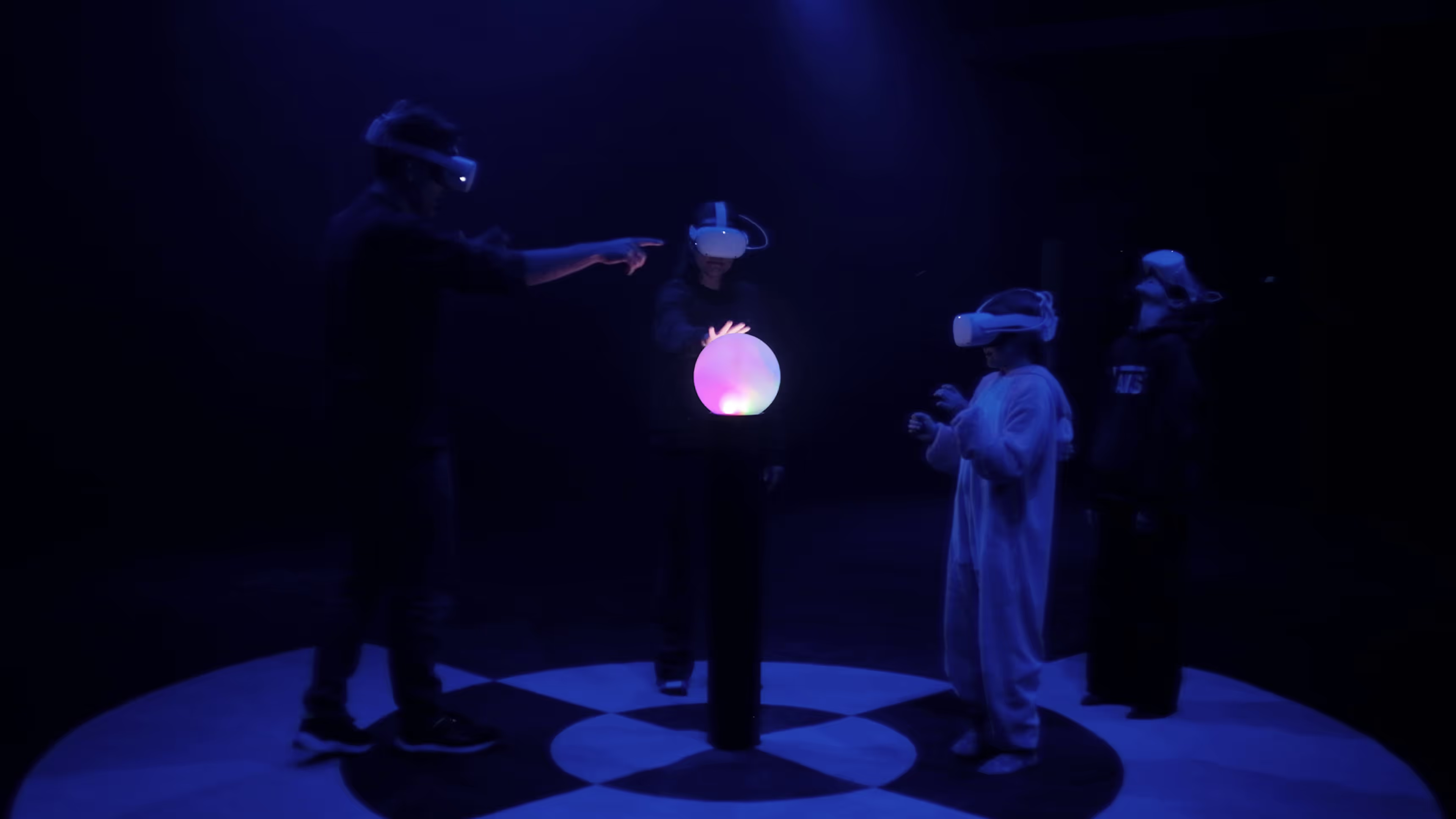
With Show Me the Light — The VR Silent Disco, developed together with Brass Rave Unit, ten people dance simultaneously in a shared virtual world. Fifteen-minute sessions, forty visitors per hour; a scale rarely achieved in immersive entertainment. Sammy explains how the multiplayer design is structured to make this work, and why standalone headsets (no heavy computers, no cables) are essential to pulling it off reliably on location.
Performance optimisation for standalone VR: less is more
When building standalone VR experiences, performance optimisation isn't a nice-to-have; it's a hard requirement. The hardware inside a standalone headset is fundamentally different from a PC or gaming console. You're building for limited processing power, limited memory, and a battery that can die mid-experience.
That demands different decisions in Unity - the platform Studio Vrij uses for XR development. Key optimisations include:
- Occlusion culling and LOD systems: only render what the user can actually see
- Draw call management: minimise the number of individual render instructions per frame
- Shader optimisation: keep materials lightweight without sacrificing visual quality
- Interaction and interface design: avoid overloading users with complexity; people come for an experience, not a manual
The guiding principle Mila shares is one we apply broadly: Keep It Simple, Stupid. Not because simplification is easy, but because overloaded experiences lose people; technically and experientially.
Grumpy Walter: conversational AI with character and guardrails
One of the most intriguing projects to come up in the conversation is the 'Grumpy' Walter Project; a conversational AI installation with a deliberately distinct personality. Walter is grumpy. He has opinions. And he talks back.
Building a character with real personality into a public installation immediately raises a critical question: how do you make sure the AI doesn't just say anything? Mila explains the approach:
- System prompts define the character's voice, limits and core behaviour
- Guardrails prevent the AI from going off-script in sensitive or inappropriate directions
- Continuous iteration refines responses based on real interactions over time
This is especially important in contexts accessible to a wide audience - including children or people in emotionally vulnerable situations, where strict behavioural guardrails are non-negotiable. The challenge is shaping the AI's behaviour without stripping away its authenticity. It's a balance between creative freedom and responsibility, and one that only becomes more relevant as conversational AI takes on a direct role in public-facing experiences.

When to use AI; and when not to
A question Studio Vrij asks on every project: when does AI genuinely add something, and when does it get in the way?
AI works well for:
- Quickly exploring and prototyping concepts
- Generating rough visual input in early creative stages
- Powering interactive characters and installations (like Grumpy Walter)
AI is deliberately kept out when:
- The handcrafted, human decisions are the heart of the experience
- AI-generated content would compromise the artistic integrity of the project
That nuance - AI as a tool, not a replacement, is exactly how we approach technology at Studio Vrij. The question is always: what does this mean for the experience of the person in the room?
Unity as a gateway into XR development
For developers interested in VR or AR development, Unity offers a relatively accessible entry point into XR development. Key advantages include extensive documentation, a large package ecosystem, and solid support for the most widely used standalone headsets.
That doesn't mean it's easy; performance tuning for standalone hardware takes experience and patience. But the barrier to entry is lower than many expect, and the community is large and active.
Listen to the full episode
Curious about all the details; including the technical deep-dives on gaussian splatting, the discussion of Roblox and Minecraft in VR, and the full story behind Grumpy Walter? Listen to the full episode at CodeKlets, episode S3E4.
Got an idea for a VR installation, an event where you want to bring in an immersive experience, or curious what location-based multiplayer VR could mean for your organisation? Get in touch; we'd love to think it through with you.